Skip to content
  • Ben-Gurion University of the Negev
  • Azrieli National Centre for Autism and Neurodevelopment Research

Guy Laban

Senior Lecturer (Assistant Professor), Department of Industrial Engineering and Management

I study how people communicate and share their emotions with artificial agents, including social robots and chatbots, and how these interactions influence social dynamics and emotional well-being.

I leadLabaLabLanguage, Affect and Behaviour in AI
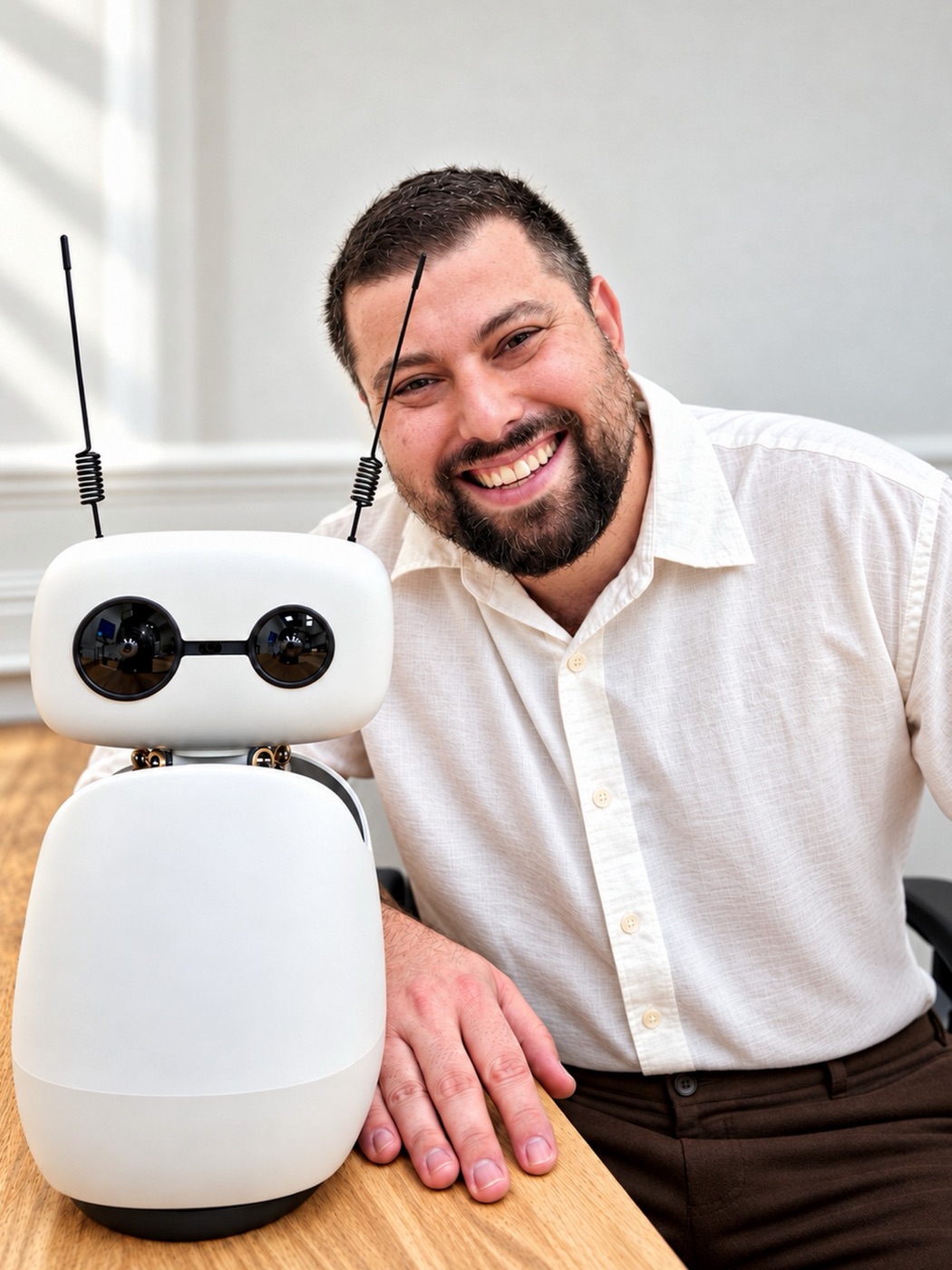
Guy Laban smiling at a desk beside Reachy Mini, a small white robot with two antennas
With Reachy Mini, one of the robots in my lab

My lab

I lead LabaLab at Ben-Gurion University.

We explore the intersection of language, affect, and behaviour in artificial intelligence, investigating how people interact with, perceive, and form relationships with AI systems.

  • Language

    What people say to chatbots and robots, and what language models say back: in the clinic, at home, and when the conversation gets hard.

  • Affect

    How emotion is expressed, recognised and regulated with machines, from opening up to a robot to reading feeling in a body with barely a face.

  • Behaviour

    What people actually do with AI over time: trust it, lean on it, argue with it. And how to build systems that stay safe when they do.

About me

I am a Senior Lecturer (Assistant Professor) in the Department of Industrial Engineering and Management of Ben Gurion University of the Negev. I am also a researcher and a member of the steering committee of the Azrieli National Centre for Autism and Neurodevelopment Research (ANCAN).

My research examines how people communicate and share their emotions with artificial agents, agents that communicate and reason using artificial intelligence, including social robots and chatbots. I study how these agents understand and interact more effectively with humans, and how these interactions influence social dynamics and emotional well-being. In my research, I am working on interactions and interventions that facilitate rich social interactions with human users to support their health in a variety of contexts.

I was a research associate at the Department of Computer Science & Technology of the University of Cambridge. I was a member of the Affective Intelligence and Robotics Laboratory (AFAR) under the lead of Prof. Hatice Gunes. Before that, I pursued my PhD studies under the supervision of Prof. Emily S. Cross (University of Glasgow & ETH Zürich) and Prof. Val Morrison (University of Bangor) at the Social Robots and Social Brain in Action labs at the Institute of Neuroscience and Psychology of the University of Glasgow. I was an ESR member of ENTWINE, the European Training Network on Informal Care, a Marie Skłodowska-Curie Innovation Training Network (ITN) funded by the European Union.

In my free time, I enjoy spending time in the mountains hiking, snowboarding, and taking photographs. See my gallery at my photography website!


Recent papers

All 58 publications

Research topics

Open a topic to see the papers and projects on it.

AI and social robots for emotion regulation

Robot- and AI-led interventions that help people regulate emotions, from expression to cognitive reappraisal and coping with distress.

Also known as: HRI for emotion regulation, robots for emotion regulation, AI emotion regulation intervention, cognitive reappraisal with robots.

Emotion expression in robots and AI

How robots and AI agents express emotion through movement, face, voice and language, and how people perceive it.

Also known as: robot emotion expression, AI emotional expression, expressive robots, affective robot behaviour.

Emotion recognition and affective computing

Recognising emotion from speech, faces and language with AI, including audio and vision language models.

Also known as: AI emotion recognition, speech emotion recognition, emotion AI, affective AI.

Affective robotics
Self-disclosure to robots, chatbots and AI

What people share with robots and chatbots, why they open up, and how it affects them over time.

Also known as: opening up to AI, talking to robots about feelings, self-disclosure in HRI, emotional disclosure to chatbots.

Social robots for mental health and wellbeing

Social robots that support emotional wellbeing, loneliness, stress, caregivers and post-traumatic stress.

Also known as: robots for mental health, social robots for wellbeing, socially assistive robots, robots for loneliness.

Loneliness, stress and social support with AI
Social robots for informal caregivers

Supporting family caregivers' emotional health with robot conversations over time.

Also known as: robots for carers, caregiver wellbeing technology.

Robots in PTSD diagnosis and treatment

How social robots could support assessment and therapy for post-traumatic stress.

Also known as: robots for PTSD, AI for trauma therapy.

Social robots for health psychology

Using social robots to improve health behaviour, health outcomes and wellbeing.

Also known as: health psychology robots, robots for health behaviour change.

Child-robot interaction and child wellbeing assessment
Psychometrics and wellbeing assessment with robots
Social robots in families and parent-child play

Robots that help parents understand their children during play.

Also known as: robots for families, parent-child interaction with robots.

Large language models for mental health and therapy

Conversational AI for case formulation, therapy dialogue and personalised mental health.

Also known as: LLMs for therapy, AI therapist, conversational AI mental health, LLM case formulation.

Safety of large language models in sensitive conversations

Psychosocial safety, empathy and harm when people bring distress and health questions to chatbots.

Also known as: LLM safety in mental health, chatbot safety evaluation, AI psychosocial safety, safe conversational AI.

Large language models for medical and health advice

How LLMs recommend tests and treatments, and where they overuse or hold back care.

Also known as: AI medical advice, LLMs in clinical decision making, chatbots for health questions, clinical AI evaluation.

Clinical decision support with AI

When structured decision models, not language models alone, should handle clinical tasks.

Also known as: AI clinical decision support, LLM vs decision models in medicine.

Empathy in AI and robots
LLM-powered social robots

Grounding robot personas and support conversations in large language and vision language models.

Also known as: LLMs in HRI, LLM robots, generative AI for social robots, large language models in human-robot interaction.

Vision language models in human-robot interaction

Robots that use vision language models to assess and talk with people.

Also known as: VLMs in HRI, multimodal LLM robots.

Robot personality and persona consistency

Keeping a robot's personality stable when it runs on a language model.

Also known as: robot personality, AI persona consistency.

AI and robots for autistic people

Social robots and AI agents designed with and for autistic children and adults.

Also known as: robots for autism, AI for autism, autism and social robots, neurodiversity and AI.

Autism inclusion and misinformation

Expert-grounded AI support for autism inclusion and countering misinformation.

Also known as: autism misinformation, AI for inclusion.

Accessible and inclusive robotics

Social robots for disabled students and people with disabilities.

Also known as: robots for disabled students, inclusive social robots.

Long-term human-robot relationships
Human-robot communication

How people and robots communicate through speech, gaze, gesture and language.

Also known as: HRI communication, robot speech interaction, conversational robots.

Embodiment: robots, virtual agents and chatbots compared
Proactive conversational agents

Agents that start conversations on their own, and how people respond to them.

Also known as: proactive AI, AI that initiates conversation, proactive chatbots.

Conversational user interfaces: ethics, bias and anthropomorphism

Ethics, fairness and human-likeness in chatbots and voice interfaces.

Also known as: chatbot ethics, AI bias in chatbots, anthropomorphism in AI, voice assistant ethics.

Conversational recommender systems and AI advice
Human-agent cooperation at work

How cooperation with conversational agents shapes service and performance.

Also known as: AI at work, human-AI teamwork.

Artificial identity and AI personas
Human-AI relationships and their social effects

How interactions with AI reshape the self, relationships and social networks.

Also known as: AI relationships, social impact of AI companions, human-AI bonds.

Multilingual and fair evaluation of clinical AI

Whether AI safety and quality hold outside English and across languages.

Also known as: multilingual LLM evaluation, AI fairness across languages, non-English clinical AI.

Dialogue simulation and evaluation tools for LLM research

Simulated users, persona-driven dialogue generation and platforms for running experiments with LLMs.

Also known as: LLM evaluation benchmarks, synthetic dialogue generation, LLM experiment platforms.

Research methods and agendas for human-AI interaction
Social robots in public and welfare services

What happens when the same robot is deployed across welfare and care services.

Also known as: robots in public services, social robots in social care, robots in elderly care.

Antagonistic and confrontational AI

AI that pushes back: dismissive, sarcastic or confrontational behaviour, and how people respond.

Also known as: antagonistic AI, rude chatbots, AI that disagrees.

AI governance, risk and insurance

How the economy of AI agents can be underwritten and made accountable.

Also known as: AI insurance, AI agent risk.

Social robots in science fiction and public perception

How fiction shapes what people expect from social robots at home and in hospitals.

Also known as: robots in science fiction, public perception of robots.

Where my work is published

Conferences

  • ACM/IEEE International Conference on Human-Robot Interaction (HRI)4 papers
  • IEEE International Conference on Robot and Human Interactive Communication (RO-MAN)8 papers
  • ACM CHI Conference on Human Factors in Computing Systems (CHI)2 papers
  • Conference on Neural Information Processing Systems (NeurIPS)1 paper
  • Annual Meeting of the Association for Computational Linguistics (ACL)2 papers
  • Conference on Empirical Methods in Natural Language Processing (EMNLP)1 paper
  • IEEE/RSJ International Conference on Intelligent Robots and Systems (IROS)1 paper
  • International Conference on Human-Agent Interaction (HAI)4 papers
  • ACM International Conference on Intelligent Virtual Agents (IVA)2 papers
  • ACM Conference on Conversational User Interfaces (CUI)2 papers
  • ACM Designing Interactive Systems Conference (DIS)1 paper
  • International Conference on Affective Computing and Intelligent Interaction (ACII)1 paper

Journals

  • Nature Machine Intelligence1 paper
  • IEEE Transactions on Affective Computing3 papers
  • Annals of Internal Medicine1 paper
  • ACM Transactions on Human-Robot Interaction1 paper
  • International Journal of Social Robotics2 papers
  • Computers in Human Behavior: Artificial Humans1 paper
  • Communications Health1 paper
  • Frontiers in Psychiatry1 paper
  • Paladyn, Journal of Behavioral Robotics1 paper
  • Current Robotics Reports1 paper
  • Intelligent Service Robotics1 paper

Contact

laban [at] bgu.ac.il

Department of Industrial Engineering and Management
Ben-Gurion University of the Negev, Beer-Sheva, Israel

Interested in joining the lab as a student or postdoc? See labalab.li/contact.